
LinkedIn restricts three things: automated actions taken on your account, tools that log in as you, and browser extensions that read the interface. In 2026 the enforcement has fallen hardest on the vendors rather than their customers. Company pages have been deleted, founder profiles restricted, and at least one long-running analytics product shut down entirely.
This guide covers what LinkedIn publishes, what actually happened in 2026 with dates, and what a lower-risk workflow looks like. It is written for founder-led sales teams who want the pipeline without the account exposure.
What LinkedIn actually publishes
Less than most vendors imply. Two things are documented:
Invitation limits. LinkedIn does not publish a single universal safe weekly invitation allowance. There is no official number to stay under, which is why every “safe daily limit” you have read is a vendor estimate, not a policy. What LinkedIn does describe are the conditions that attract a restriction: a low acceptance rate on recent invitations, a large share of old pending invitations, and invitations sent without relevant context.
Personalized invitations. Basic members get three personalized invitations per month, with a note capped at 200 characters. Premium members can personalize all connection requests. Some invitation surfaces cannot be personalized at all, so the composer in your current app is the only reliable check.
Everything else about “limits” is inference. Treat confident numbers with suspicion, including the ones in tool marketing.
The 2026 enforcement record
Three documented cases, in order.
| Date | What happened |
|---|---|
| 25 March 2026 | LinkedIn removed the HeyReach company page and restricted the personal profiles of its CEO, CTO, CRO and CMO. Customer accounts, campaigns and the platform itself kept running. |
| Early 2026 | LinkedIn’s legal team issued a cease and desist to Kleo demanding it stop scraping the LinkedIn interface. The Chrome extension, which had reached roughly 70,000 users, was shut down and the product was rebuilt as a paid web application. |
| 18 May 2026 | Shield wound down after seven years and more than 10,000 users. Its own statement was that both Google and LinkedIn had made clear it could not continue operating as built. |
Two patterns are worth naming.
The vendor is the target, not the customer. In the HeyReach case the product continued working and customers kept sending. What LinkedIn removed was the company’s ability to reach its own audience and the founders’ personal profiles. If you are choosing a tool, the risk you are underwriting is mostly continuity risk, not an immediate ban on your own account. That is a risk to price, not a reason to treat every automation vendor as radioactive: Embers ships a native HeyReach destination, and the boundary it keeps is its own. Embers never sends connection requests, messages, comments, or reactions on LinkedIn. HeyReach does. Embers pushes leads and reads results.
The founder’s channel is the asset that gets taken. For a company that sells through founder-led LinkedIn content, losing the executives’ profiles is a larger commercial event than losing the company page.
Why “we use the official API” is not the safe harbour it sounds like
This is the most misread fact of the year. Shield used the official LinkedIn API, the sanctioned route, and still could not continue. Access to the sanctioned route is granted, and it can be narrowed.
The structural position in 2026:
- The Sales Navigator API is closed to new partners.
- The permission covering member post management is a closed permission, not open to new access requests.
- The Community Management API covers the authenticated organisation’s own pages and the authenticated member’s own posts.
Read together, that means there is no permitted API route to read who engaged with a third party’s LinkedIn post. That is a condition of the market rather than a gap any one vendor has engineered around, and it is equally true of every tool in this category. Any product claiming sanctioned access to that data is describing something else.
What actually reduces your risk
Rank the options by what touches your account, not by feature count.
Highest risk: tools that log in as you. Anything asking for your LinkedIn password, session cookie or browser session is operating your account. Actions it takes are attributable to you, and a restriction lands on your profile rather than the vendor’s.
High risk: browser extensions that read the interface. This is the category LinkedIn’s legal team has pursued directly, and it carries a second dependency on the Chrome Web Store. Both of the shutdowns above involved that surface.
Lower risk: automated sending with your credentials, run from a server. Removing the extension does not remove the core issue. Something is still acting as you.
Lowest risk: reading public engagement and acting manually. Nothing logs in, nothing sends, and the follow-up is a message you write and send yourself from LinkedIn. You give up scale, which is the actual trade, and you keep the account.
The honest trade-off
A manual workflow will not send 500 connection requests a week. If volume is your strategy, no amount of positioning changes the exposure you are taking on, and you should at least take it knowingly.
What a manual workflow does well is the part volume tools are bad at: deciding who is worth contacting. Most engagement on any post is politeness. A small number of people are in-market. Sorting one from the other is where the return is, and it carries no account risk at all because it is a reading problem, not a sending problem.
That is the approach Embers takes. It reads public engagement on your posts, the comments you leave, chosen competitors and keywords, scores each person against your ICP, and hands you a ranked queue with a reason. It never asks for your password, sets no cookies, ships no extension, and sends nothing on your behalf.
If you want the category boundary in more detail, the comparison hub sets Embers against the automation tools directly.
Frequently asked questions
Is LinkedIn automation against the terms of service?
Automated actions on your account and scraping the interface both conflict with LinkedIn’s user agreement. Enforcement in 2026 has focused on vendors rather than individual users, but the exposure sits on whichever account the automation runs through, which is yours.
How many connection requests can I safely send per week?
LinkedIn does not publish a universal safe number, so any specific figure is a vendor estimate. What LinkedIn does describe are the risk conditions: low acceptance rates, many old pending invitations, and invitations sent without context.
Did LinkedIn ban HeyReach?
On 25 March 2026 LinkedIn removed HeyReach’s company page and restricted four executives’ personal profiles. The product, customer accounts and campaigns continued to operate, so it was an action against the company’s presence rather than a shutdown of the service.
Why did Shield shut down if it used the official API?
Shield wound down on 18 May 2026 after seven years, stating that both Google and LinkedIn had made clear it could not continue operating as built. Using the sanctioned API did not protect it, because access to that route can be narrowed by the platform at any time.
Is a Chrome extension safer than a login-based tool?
No. An extension reads the LinkedIn interface, which is the surface LinkedIn’s legal team has pursued directly, and it adds a dependency on the Chrome Web Store. Both 2026 shutdowns above involved that surface.
Reading about LinkedIn lead gen? Check who's already engaging on your topics.
Free Signal Audit. One public signal, no email. Up to three with a work email. No card.
Scan a keyword free →No card. One public signal free. A work email unlocks up to three.
Related articles
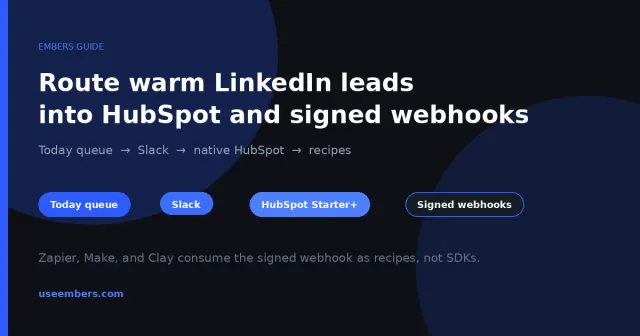
Route Warm LinkedIn Leads to HubSpot With Signed Webhooks
Move Embers Priority Queue leads into Slack, native HubSpot, and signed webhooks, all on Solo and above. Zapier, Make, and Clay use recipes, not SDKs.
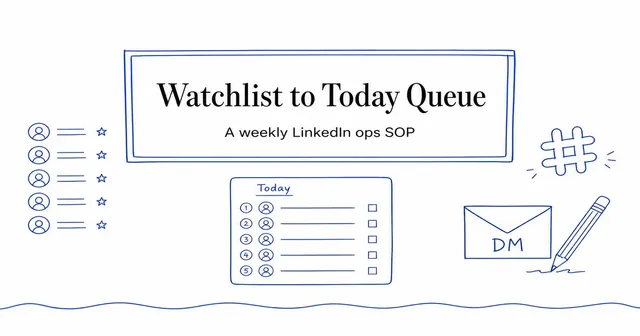
Watchlist to Today Queue: A Weekly LinkedIn Ops SOP
A weekly operating SOP for picking watched profiles within plan caps, running the Priority Queue, handing off in Slack, and sending every LinkedIn DM yourself.
Best LinkedIn Engagement Tracking Tools for Warm Leads (2026, With Pricing)
Eight tools that turn LinkedIn post likes and comments into lead lists, compared on signal coverage, account safety, and real 2026 pricing. Includes the manual method.