
Most LinkedIn outreach fails before the message is sent.
The founder builds a list, opens a profile, scans the headline, and sends a polite version of the same note everyone else sends. The prospect does not know them. The timing is unclear. The message has no connection to anything the prospect just did or said.
That is not a copy problem. It is a strategy problem.
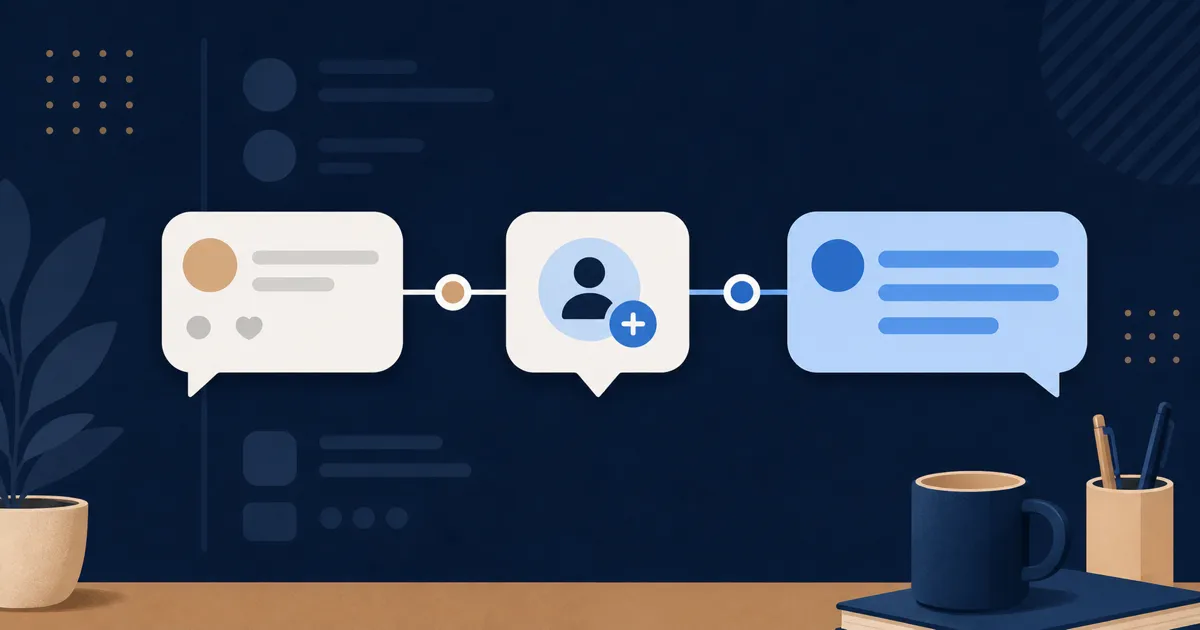
A better LinkedIn outreach strategy starts before the DM. You engage publicly first, connect with context, then move the conversation private only when there is a real reason. The goal is not to make every message warmer with a fake first line. The goal is to create the context before you ask for attention.
LinkedIn’s own buyer research backs up the direction. In a survey with Ipsos, LinkedIn reported that 78% of B2B buyers strongly agree sales outreach should be personalized. The same article argues that buyers want sellers who understand their business and know when to reach out.
For founders, that is the opening. You do not need more automation. You need a repeatable way to notice the right moments, show up usefully, and send fewer messages with better context. Before you work the sequence, use the free LinkedIn SSI Score Checker to spot whether your profile and public activity give a prospect enough reason to recognize you.
The Engagement-First Framework
Engagement-first outreach has four steps: comment, connect, context, conversation.
Comment. Start in public when the prospect has already entered a relevant conversation. That could be their own post, a comment they left on another thread, a repost, or a discussion around a problem your product helps solve.
Connect. Send the connection request only after there is a real reason for your name to appear. The connection note should reference the public moment without over-explaining it.
Context. Once connected, continue from the same thread. The first DM should not pretend the relationship is deeper than it is. It should make the bridge obvious: “I saw your point about X, and it made me wonder Y.”
Conversation. Ask a question that is easy to answer. Do not force a meeting in the first message unless the signal is unusually strong. The first win is a relevant reply.
This works because the prospect can reconstruct why you are there. They saw your comment. They accepted the connection. The DM references the same problem. Nothing feels like a context switch.
That is the difference between personalization and relevance. Personalization says, “I saw you went to Stanford.” Relevance says, “You just described the exact workflow breaking inside your team.”
If you are building a broader LinkedIn acquisition motion, pair this with the LinkedIn lead generation strategies guide. That piece covers the larger channel mix. This one is about the outreach sequence itself.
How to Find Prospects Worth Engaging With
The best prospects for LinkedIn outreach are not always the people with the cleanest title match. They are the people where fit and timing overlap.
Start with fit. Your first filter is still ICP: company size, role, market, stage, geography, and the problem your product solves. A relevant signal from a bad-fit account is still a bad use of time.
Then look for timing. On LinkedIn, timing usually shows up as a public action or a company change:
- A target persona comments on a post about the problem you solve.
- A founder announces a new GTM push.
- A company hires its first SDR, growth lead, or content marketer.
- A buyer changes roles into a company that matches your ICP.
- Someone from a target account engages with your founder’s content.
- A prospect asks for recommendations around your category.
- A leader posts about a workflow that is clearly painful.
Those are buying signals, but they are not all equal. A like is weak. A comment with problem language is stronger. A public request for recommendations is stronger still. A job change plus a category comment may be worth immediate outreach.
The easiest founder workflow is a daily watchlist. Keep 50 to 100 target accounts, then spend 15 minutes looking for recent activity from the people who matter inside those accounts. You are not trying to read the entire feed. You are looking for changes that create a good reason to speak.
LinkedIn’s 2024 Deep Sales Playbook summary says top-performing sales professionals are more likely to hit quota by focusing on high-opportunity accounts, key relationships, and network-informed outreach. It also notes that buyers say understanding their business needs is the most important step sellers can take to increase purchase likelihood.
That is the standard. Do not engage because someone has a title. Engage because their activity tells you what conversation might actually matter.
What to Comment, and What Not To
The comment is not a miniature pitch. It is proof that you understand the conversation.
Good comments do one of four things:
- Add a concrete example.
- Name a tradeoff the original post missed.
- Ask a sharp follow-up question.
- Summarize the operating lesson in simpler words.
Weak comments do the opposite. They praise without adding anything, repeat the post back to the author, or try to turn the thread into a demo request.
If a VP Sales posts about low outbound reply rates, a weak comment is:
Great post. Totally agree that personalization matters.A useful comment is:
The hard part is that most teams personalize after the list is built.

The better filter is before the list: which accounts showed a reason to hear from us this week?
That kind of comment can start a conversation because it adds a position. It also gives you a cleaner private follow-up if the person replies, likes the comment, or views your profile.
This is where social selling on LinkedIn and outreach meet. Social selling builds familiarity and credibility in public. Outreach turns the right public moments into one-to-one conversations.
The reason this matters is not just algorithmic reach. The 2025 Edelman and LinkedIn B2B Thought Leadership Impact Report argues that high-quality thought leadership helps earn trust, differentiate suppliers, and influence people inside buying groups who may never fill out a form. Your comments and posts are small versions of that same trust-building motion.
The Connect-and-Context Message Structure
Your connection note should be short. The follow-up DM can carry more context.
Use this structure:
- Reference the public moment.
- Name the business problem underneath it.
- Ask a question that does not require a calendar.
For example, if the prospect commented on a thread about outbound quality:
Saw your comment on the thread about outbound quality.

The point about timing stood out. Are you mostly using CRM activity to decide who gets outreach, or are LinkedIn signals part of that workflow too?
If a founder announces a new GTM motion:
Congrats on the new GTM push.

When founders move from referral-led to outbound, the hardest part is usually deciding who deserves attention first. Are you building that around account lists, recent signals, or both?
If someone engages with your post about LinkedIn engagement turning into pipeline:
Thanks for engaging with the post on LinkedIn engagement and pipeline.

Curious if that is a live problem for your team, or if it just matched a pattern you are seeing in the market?
Notice what these messages do not do. They do not ask for 15 minutes. They do not mention every feature. They do not pretend a like means budget. They ask a question that lets the prospect reveal whether the problem is real.
When the reply comes back, the next step depends on the answer. If they say the problem is live, ask one more diagnostic question or offer a relevant resource. If they say it is just market curiosity, keep the relationship warm. If they do not reply, do not punish them with a six-step sequence.
Cadence and Reply Benchmarks
There is no magic LinkedIn cadence that fixes weak context. A bad message sent three times is just a louder bad message.
For founder-led outreach, keep the sequence short:
Day 0: public comment. Comment only if you can add something useful.
Day 1 or 2: connection request. Reference the thread or signal in one line.
Day 2 or 3: context DM. Ask one specific question tied to the signal.
Day 6 or 7: follow-up. Add a useful observation, resource, or practical next step.
Day 14+: exit or switch channel. If there is no reply and the account is still important, move to email with a new angle. Do not keep poking the same LinkedIn thread.
What reply rate should you expect? Benchmarks vary because list quality, category, buyer seniority, and brand familiarity change the math. Treat any public reply-rate claim as a weak guide unless it shows the audience and sample.
A better benchmark is your own weekly conversion through the sequence:
- How many useful public comments did you leave?
- How many target prospects accepted the connection?
- How many replied to the first context DM?
- How many replies became discovery conversations?
- Which signal type created the highest-quality replies?
That last question matters most. If job changes produce polite replies but no meetings, lower their score. If comments on competitor posts produce fewer replies but better conversations, prioritize them. Your outreach strategy should get sharper every week.
The founder-led sales motion depends on this feedback loop. You are not only trying to book meetings. You are learning which moments predict real demand.
When to Escalate to Email
LinkedIn is not the whole sequence. It is the context layer.
Escalate to email when one of three things is true.
First, the account is high priority and the prospect accepted your connection but did not reply. Email lets you bring the same context into a channel where they may manage work more deliberately.
Second, the signal is company-level rather than person-level. A hiring post, funding announcement, new market launch, or executive change may justify emailing the most relevant buyer even if the LinkedIn activity came from someone else.
Third, the conversation needs a more complete note. If you are sending a teardown, a short Loom, a customer example, or a practical checklist, email often carries that better than a DM.
The email should still reference the LinkedIn context. Do not restart cold.
Subject: your post on outbound timing

Hi Maya,

I saw your LinkedIn thread about outbound reply rates and left a thought there.

The part that stood out was timing. A lot of founder-led teams we see have decent lists, but no daily way to tell which accounts got warmer this week.

Are you already tracking post engagement, job changes, or hiring signals before deciding who gets outreach?
That message works because the email has a trail. It is still outbound, but it is not disconnected from the prospect’s recent behavior.
For tactical prospecting inputs beyond LinkedIn engagement, the LinkedIn prospecting guide is a useful next read.
What This Looks Like With Embers
The strategy is simple. The daily execution is the hard part.
A founder can remember a few obvious signals. They cannot manually watch every prospect, every post, every job change, every comment, and every warm account without losing half the day.
That is where Embers fits. Embers turns public LinkedIn engagement and account activity into a daily action queue. It helps you see who engaged, which accounts match your ICP, and what context makes the outreach worth sending.
You still write like a human. You still decide what is worth saying. Embers handles the watching, filtering, and prioritizing so your outreach starts from a real signal instead of a cold list.
If LinkedIn is part of your founder-led sales motion, start a free trial and build the habit around the right people, not the loudest feed.
Reading about LinkedIn lead gen? Check who's already engaging on your topics.
Free Signal Audit. One public signal, no email. Up to three with a work email. No card.
Scan a keyword free →No card. One public signal free. A work email unlocks up to three.
Related articles
The LinkedIn Post Engagement to DM Playbook: From Like to Conversation in 3 Steps
How to turn LinkedIn post likes, comments, and reshares into qualified conversations. Timing, message structure, and reply benchmarks.
LinkedIn Cold Outreach Without Burning Your Account or Reputation
A LinkedIn cold outreach approach that uses public engagement as a bridge. Limits, message structure, and what to do when someone says no.
How to Find LinkedIn URL: 2026 Guide for Better Outreach
Learn the best ways to find linkedin url profiles for sales and networking. Our 2026 guide covers quick search methods and advanced outreach tips.